
By Bassey Udo

Nigeria appears to still tread precariously on a tight rope despite efforts by civil society to rally its constituents to work towards supporting the country avert an impending sanctions by the global Extractive Industries Transparency Initiative (EITI).
Recent media reports suggest Nigeria may not have done enough in the run up to the commencement of the 2026 EITI Validation exercise scheduled to commence next week to avoid its possible suspension from the global transparency group.
Indications are that the country may be behind schedule in meeting key timelines and actions ahead of validation deadline.
Civil society rallies constituents
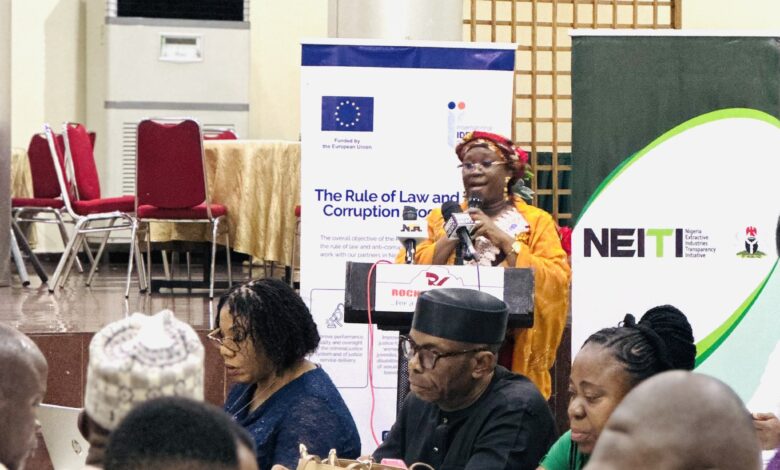
In a bid to attempt to save the country from the embarrassment an EITI sanctions might cause, civil society groups involved in the Nigeria Extractive Transparency Initiative (NEITI) process on Wednesday converged on Abuja for a make or break stakeholder consultative meeting aimed at reviewing their preparedness towards the July 1, 2026 deadline for the commencement of the 2026 EITI Validation exercise.
The meeting facilitated by the CSO Representative on the National Stakeholder Working Group (NSWG), also known as the NEITI Board, Dr Erisa Danladi, was supported by International Institute for Democracy and Electoral Assistance (IDEA) in conjunction with Rule of Law and Anti-Corruption (RoLAC), a European Union (EU) funded programme.
Danladi said the meeting was meant to brief the CSOs and provide updates on the progress towards the validation process; clarify various stakeholders’ roles as well as the level of preparedness of Nigeria for the all important exercise considered critical to assess and revalidate member countries’ level of compliance with EITI standards, in terms of transparency in the management of its oil, gas and mining sectors.†
Trigger for the meeting
The meeting became necessary after reports emerged in the media about the potential risks Nigeria was facing, in terms of being suspended from the global EITI body if the country fails to meet the minimum threshold for revalidation to continue under the EITI process.
The reports had revealed that the global EITI Board, in its resolution published on its website on June 3, 2026, rejected Nigeria’s request for an extension for 12 months the deadline for the commencement of the validation exercise from July 1, 2026 to to July 1, 2027 to enable it tidy up a few knotty issues thrown up by unforeseen national constraints.
In rejecting Nigeria’s request, the International Secretariat of the EITI Board insisted on keeping its July 1, 2026 schedule for the validation exercise, a development that triggered emergency actions to save Nigeria the blushes of being sanctioned for non-compliance with its stipulated standards and principles.
Requirement to participate in validation
Under the EITI process, a key action to demonstrate the preparedness of a country to participate in its revalidation exercise is the mandatory publication of its annual industry report several months ahead of the deadline set for the commencement of the validation exercise.
The argument in support of such publication is always that it would allow for exhaustive debates and discussions on the report’s findings and recommendations in terms of compliance by the operating companies and government handling of transparency and accountability issues during the year.
In line with the provisions of the EITI Standards, an implementing country might risk serious sanctions, including temporary suspension from the EITI, if it fails to either meet the reporting deadline prior to the next validation; record adequate progress on EITI implementation, or meet the EITI’s requirements on stakeholder engagement.
NEITI Audit Report not ready
For Nigeria,few days to the July 1, 2026 deadline set for the commencement of the validation exercise, despite the last minute effort by civil society to avert the inevitable consequence, it appears the country is still treading the dangerous path, as a key component of the requirement to assess a country’s readiness – the publication of the 2024 NEITI Audit Report is yet to be achieved.
In appealing to the EITI Board for a validation deadline extension, the plank of the NEITI Board request was on “unforeseen national budgetary constraints and fiscal deficits in the Federal Government’s 2025–2026 Appropriation” which resulted in delays in the disbursement of funds to NEITI Secretariat for the procurement of an Independent Administrator to finalize and produce the 2024 NEITI Report before the validation deadline.
Although NEITI planned to publish the report latest by April 2026, it said paucity of funds informed its decision to shift the publication till next October.
NEITI’s frustrations
Speaking during the CSO meeting on Wednesday, NEITI Executive Secretary, Musa Sarkin-Adar, who acknowledged NEITI was behind schedule in publishing the 2024 Audit Report, highlighted the frustrations NEITI was battling with the operating companies in the EITI process, which might be another reason for the delay in getting the report published.
Sarkin-Adar said one of such frustrating experiences has to do with the lack of cooperation from key government agencies, including the Nigerian National Petroleum Company (NNPC) Limited, Central Bank of Nigeria (CBN), Revenue Mobilisation, Allocation and Fiscal Commission (RMAFC), the Federal Ministry of Finance, and the Budget Office of the Federation, many of which, he said, often failed to respond to correspondences from NEITI in a timely manner.
“Most of these places, when we write letters to them, they do not respond immediately or on time. Some of them, we have to even put reminders. It’s very unfortunate,” he said, adding that NEITI’s role as an enabler and whistleblower, not a regulator, was widely misunderstood.
Crowded schedule towards validation deadline
In the run up to the July 1, 2026 validation exercise, Sarkin-Adar disclosed that a number of consultative meetings were being scheduled, including an Inter-Ministerial Task Team engagement for June 26, followed by a companies’ engagement on June 29, and a National Stakeholder Working Group, or NEITI Board meeting on June 30 to finalise the templates due for upload to the EITI website prior to the July 1 deadline.
After the deadline, he said a high-powered EITI Validation delegation is expected in Nigeria from August 10 on a two-week working visit.
Call for unity
The Chairman of the NEITI Board, who is also the Secretary to the Government of the Federation, George Akume, said in view of the decision by the EITI Board to reject Nigeria’s request for an extension of the validation timeline, the right situation the country has found itself demanded an immediate, unified action to emerge strong at the end of the exercise.
Akume, who was represented by South South representative on the NEITI Board, Dr Stephen Akpan, described the 2026 validation as a common goal uniting all stakeholders, stressing the need for closer collaboration with NEITI to ensure a successful outcome.
In her introductory remarks, the Civil Society representative on the NEITI Board and National Coordinator of the Resource Justice Network, Dr. Erisa Danladi, said the constraining situation Nigeria is facing with the forthcoming validation exercise called for deeper commitment by civil society to the process.
For Nigeria scale through the validation hurdle, she said civil society groups must demonstrate deeper community-level engagement, stronger follow up on NEITI recommendations, and greater transparency in areas such as beneficial ownership, contract disclosure, and environmental compliance.
Beyond assessing Nigeria’s compliance with the EITI Standard, she said the validation process should provide an opportunity for civil society to take stock of their collective achievements, identify existing gaps, and explore practical ways of strengthening transparency, accountability and good governance within Nigeria’s extractive sector.
Nigeria’s sterling record under threat
Since joining the EITI in 2004, Nigeria has been acquitting itself as a pacesetter among the 55 member-countries, in terms of high scores in compliance with set criteria for validation of EITI implementing countries.
At the end of the 2023 Validation exercise, Nigeria achieved a moderate score (72 points) in its implementation of the 2019 EITI Standard, with overall score reflecting an average of 52.5 points for Stakeholder engagement), 71.5 points for Transparency, and 92 points for Outcomes and impact.
But, there were some shortcomings the EITI Board identified in its final report, which required corrective actions by Nigeria to remedy them prior to the January 2026 deadline ahead of the commencement of the next validation exercise on July 1, 2026.
These shortcomings were in respect of government, industry and civil society engagements, multi-stakeholder group governance, contract and license allocations, license register, contracts, beneficial ownership, and state participation.
Others included barter agreements and infrastructure provisions, level of disaggregation, distribution of extractive industry revenues, subnational transfers, social and environmental expenditures and state-owned enterprises’ quasi-fiscal expenditures.
Specifically, the Board warned that failure to demonstrate progress on stakeholder engagement, transparency or outcomes may attract serious consequences, including temporary suspension in accordance with Article 6 of the EITI Standard.
It is not yet clear what impact the non-publication of the 2024 NEITI Report will have on the overall assessment of Nigeria’s preparedness to participate in the validation process come July 1.
But an energy industry expert, who is very familiar with the EITI process, said all indicators point at Nigeria walking a tight rope.
“I don’t want to sound like a doomsday tale bearer. The indicators are not looking nice. It will take a miracle for Nigeria to escape the EITI noose,” the expert said. He asked that his identity should not be revealed for personal reasons.