
By Bassey Udo

Two digital portals designed to improve public access to local governance data on Nigeria’s 774 local government areas as well as a digital repository for all government policies were unveiled on Thursday in Abuja.
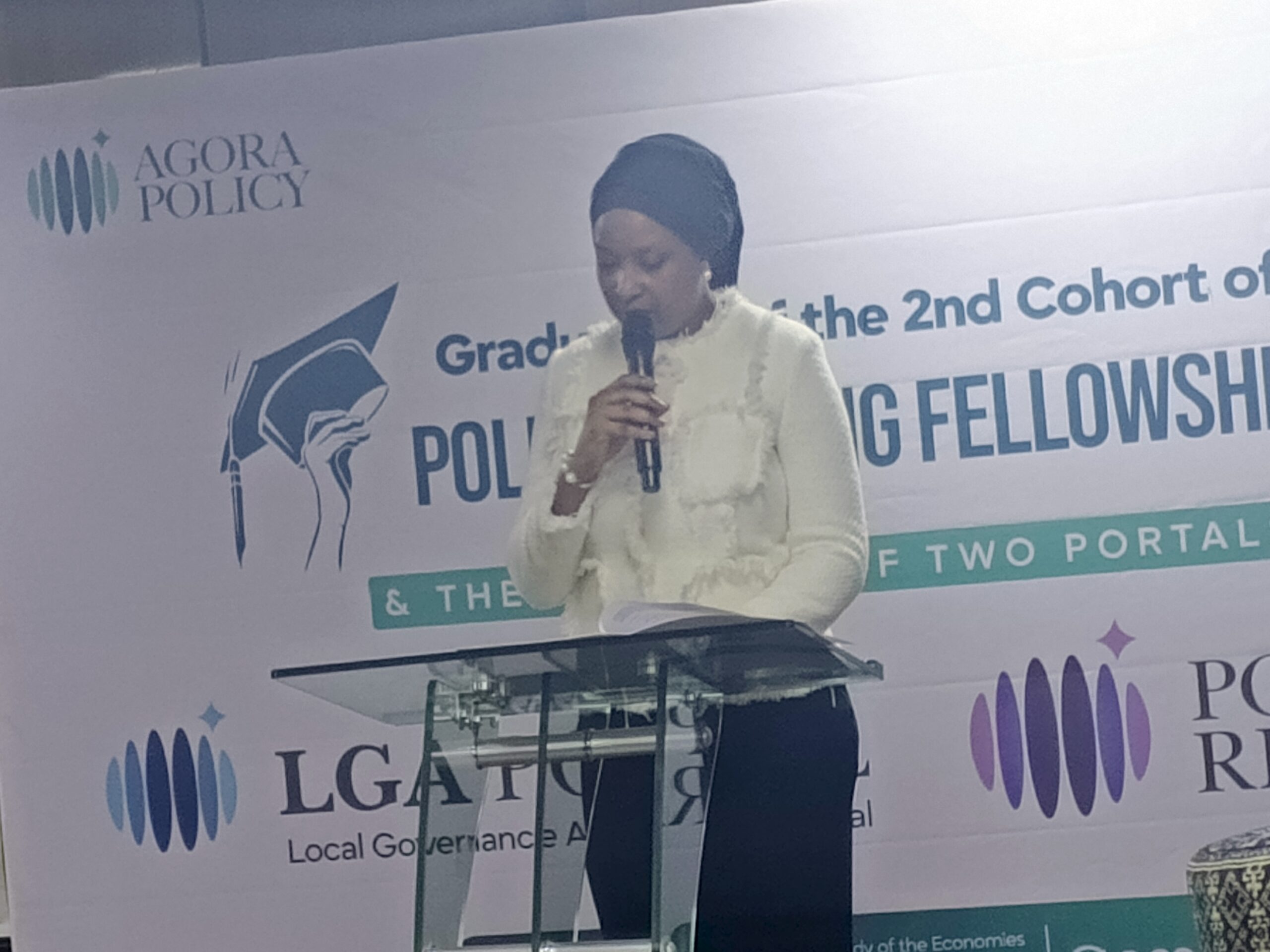
Agora Policy, an Abuja-based policy think tank, which developed the portals, also graduated the second cohort of its Policy Writing Fellowship aimed at enhancing the capacity of competitively-selected mid-career professionals to conceive, research and write compelling and impactful policy papers.
At the formal unveiling of the portals, the Founder/Executive Director of Agora Policy, Waziri Adio, said the two digital platforms, which incorporate AI-enabled search tools to improve the discovery and use of policy resources, would enhance transparency, accountability and the quality of policymaking and policy conversation in the country.
Apart from serving as a digital repository for all government policy documents, reports, frameworks, strategies and other governance resources, Mr Adio said the Policy Registry, https://www.policyregistry.org, would also bring together policy documents in a searchable and accessible format to support research, policymaking, public learning and institutional memory.
Similarly, he said the Local Governance Accountability portal would provide users with historical and current data on the monthly statutory allocations to the local councils from the Federation Accounts Allocation Committee; information and profiles of all the LGAs, along with data on elected officials, as well as data visualisation tools for research, analysis and citizen engagement.
Adio said the LGA portal, https://www.lgaportal.org, was developed by Agora Policy in partnership with The Cable, the Centre for Fiscal Transparency and Public Integrity (CFTPI),and the Punch Media Foundation to promote greater transparency, accountability and public participation in local governance by empowering citizens and civic groups with accessible and
Besides, he said the Policy Writing Fellowship, along with the two portals, were part of the series of activities under Policy Support, Deepening and Engagement (PSDE) project by Agora Policy, supported by the John D. and Catherine T. MacArthur Foundation, to strengthen evidence-driven and participatory approaches to policymaking and governance in the country.
During the Fellowship, he said participants underwent intensive four-month training that culminated in individual policy papers covering diverse topics, ranging from artificial intelligence, disease-containment strategies, air quality, food security, to job creation, gender equity, and industrial policy.
“Together, the launch of the two platforms and the graduation of the fellowship reflect Agora Policy’s strong commitment to strengthening Nigeria’s policy ecosystem and facilitating evidence-led policymaking and policy engagement in the country,” Mr Adio said.
During the ceremony, apart from presentation of certificates to the graduating fellows, guests watched the demonstration of both digital platforms to show their application and the importance of public access to governance and policy information.
In her address, Special Adviser to the
President on Policy Coordination and Head of the Central Results Delivery
Coordination Unit, Hadiza Bala Usman,
commended Agora Policy for its contribution to the country’s policy landscape as a non-partisan think tanktank committed to rigorous research, data-driven analysis and
constructive engagement to deepen public understanding and strengthen the quality of policy discourse.
She said initiatives such as the Policy Writing Fellowship would help to cultivate the discipline of evidence, the habit of rigorous analysis, and the capacity to translate complex public problems into clear and practical policy arguments.
Acknowledging the abundance of ideas in Nigeria, she said across sectors, there were plans, strategies, committees, reports, white papers and reform proposals.
She however noted that the more difficult task has always been to convert ideas into priorities, priorities into institutions, institutions into implementation,
and implementation into measurable improvements in the lives of citizens.
“This is the central challenge of governance. It is also the central
opportunity before public policy scholars, practitioners, civic actors and
public officials,” she said.
She said democracy was sustained by participation, communication, shared responsibility and the continuous engagement of citizens in the affairs that shape their lives.
Highlighting the benefits of the two portals, the Special Adviser said the idea was especially relevant to public policy and governance, as democracy becomes stronger when citizens have access to information, when institutions are responsive, when public choices are explained, and when government performance can be examined against evidence.
“Evidence-based policy is not only about improving administrative efficiency. It is also about strengthening democratic life. It allows citizens to move from speculation to informed engagement. It allows public officials to move from assumptions to measurable priorities. It allows researchers and civic actors to move from general
criticism to constructive accountability,” she said.
In his goodwill message, the
Chairman, Code of Conduct Bureau, Dr. Abdullahi Usman Bello, congratulated the Fellows who graduated from the programme, saying they represent the kind of thoughtful, evidence-driven leadership Nigeria needs towards building stronger institutions and improving the lives of the citizens.
Bello said the LGA Portal, which provides free access to financial allocations to local councils from 1999 to date, together with council profiles and the names of elected officials, was a powerful instrument for promoting transparency and accountability at the grassroots level.
He said the LGA database was particularly important to the Code of Conduct Bureau as he was of the firm conviction that sustainable national development and the fight against corruption must begin with strong, accountable local governance.
The LGA portal, he noted, would empower citizens, researchers, journalists, and civic actors to monitor public resources and demand better service delivery, by directly supporting the Bureau’s collective efforts to entrench integrity and ethical conduct in public service.
As part of the Bureau’s ongoing efforts to strengthen integrity and accountability in public service, Bello disclosed that it has completed verification of asset declarations for high-risk public servants, covering 19 Ministers, 37 Permanent Secretaries, 20 Heads of Agencies, and 32 other high-risk officials.
Announcing that the Bureau’s Online Asset and Liabilities Declaration System was now 100% developed and ready for deployment and testing, he said this platform would hold the asset declaration database of all public servants in Nigeria.
As part of its enforcement drive, the Chairman said the Bureau has also secured the forfeiture of several assets, including a property of one high profile public official located in London.
“We have referred numerous cases to the Code of Conduct Tribunal. Just yesterday (Wednesday) we arraigned the Chief of Staff to a State Governor before the Tribunal,” he said.
“The Chairmen of five Local Government Councils are currently being probed by the Bureau in connection with the utilization of Council’ funds as well as other activities bordering on conflict of interest issues,” he said.
These actions, he pointed out, demonstrate the Bureau’s firm resolve to hold public officers accountable regardless of their position or status.
He enjoined the graduating Fellows sustain the spirit of inquiry, integrity, and public service in all their future endeavours, adding that the knowledge, skills, and networks they gained from the programme should be deployed to address the country’s challenges and to strengthen governance at every level.
On her part, the Chief Executive Officer, Nigerian Financial Intelligence Unit (NGIU), Hafsat Abubakar Bakari, in her goodwill message commended Agora Policy for its commitment to evidence-driven and inclusive policymaking, saying it has worked consistently to provide government actors with rigorous, actionable alternatives.
She said the unveiling of the two portals and the graduation of the second set of participants in the Policy Writing Fellowship was further testament to Agora Policy’s role in bridging data analysis and practical statecraft.
To fix Nigeria’s systemic challenges, he said the intellectual and technical capacity of those who design and monitor government policies must be built to support initiatives targeting corruption, criminal justice, and civic accountability.
In terms Anti-Money Laundering, Countering the Financing of Terrorism, and Countering Proliferation Financing (AML/CFT/CPF), she said Nigeria was currently updating its National Risk Assessment, a major multi-agency undertaking to update the country’s National AML/CFT/CPF Strategy and Action Plan.
These plans, she said, were to prepare for Nigeria’s Mutual Evaluation by GIABA in 2027, which would assess both the country’s technical compliance and the effectiveness of its regimes.
She challenged the Graduating Cohort to avail their knowledge to the strategic policy contributions to Nigeria’s AML/CFT/CPF frameworks by helping the NFIU design policies to close the financial loopholes exploited by terrorists, economic saboteurs, and corrupt actors.
Executive Chairman, Economic and Financial
Crimes Commission, EFCC, Ola Olukoyede,who was represented at the occasion, applauded Agora Policy for these initiatives to help solve the twin problems of policymaking and implementation, which have undermined the country’s development for a long time.

