

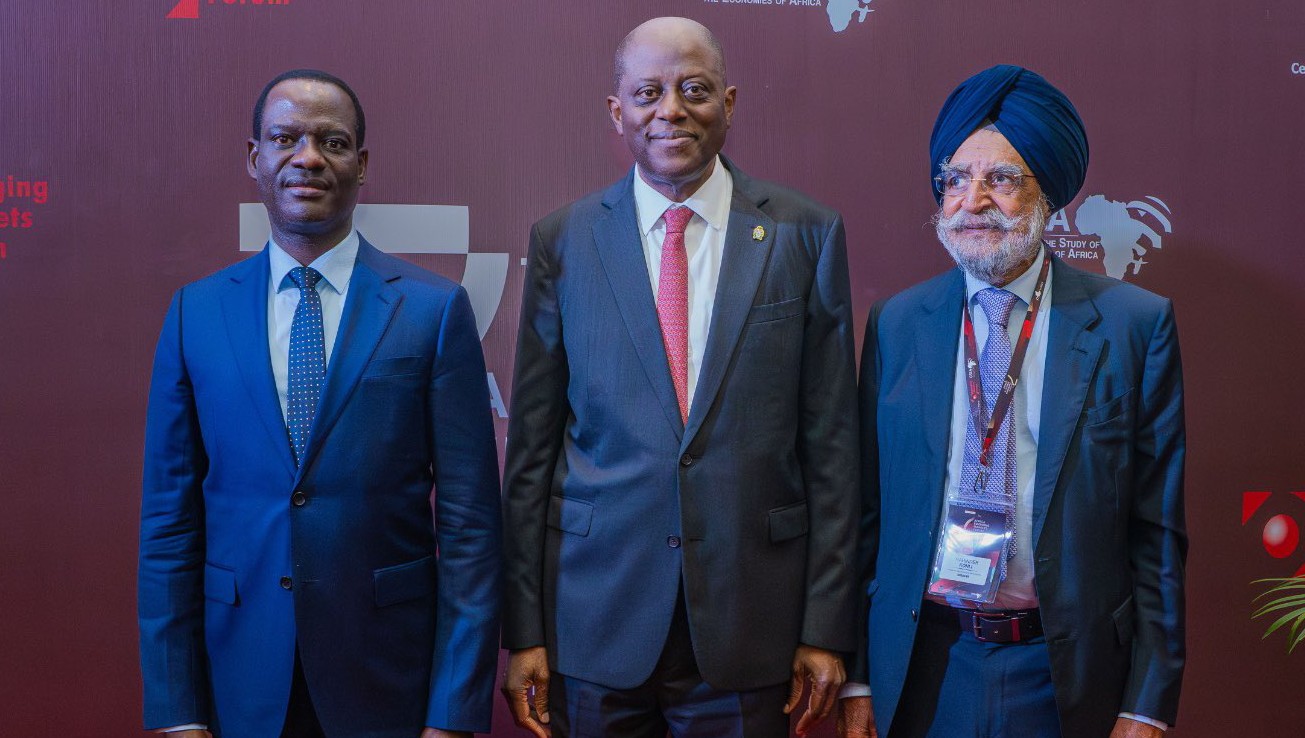
PICTURE Caption: L-R: Minister of Finance and Coordinating Minister of the Economy, Taiwo Oyedele, with CBN governor, Olayemi Cardoso, and Founding Director/Chief Executive, Emerging Markets Forum, Harinder S. kohli at the African Emerging Markets Forum in Abuja on Thursday.

By Bassey Udo
The three-year reform programme embarked upon by the present administration has restored macroeconomic stability and established a Nigerian economy that is now more competitive, productive and resilient, Minister of Finance and Coordinating Minister of the Economy, Taiwo Oyedele, has said.
Oyedele, who spoke at the two-day Africa Emerging Markets Forum organised by the Central Bank of Nigeria (CBN) in Abuja on Thursday said the economy is at the post-reform point to convert the gains into investment, productivity and creation of jobs for NIgerians.
The Minister, who was addressing a mixed audience made up of investors, bankers and policymakers, insisted that the Federal Government’s target of building a $1 trillion economy by 2030 was a concrete goal, rather than a mere political slogan.
Oyedele framed Nigeria’s experience within a broader argument about Africa’s place in a shifting global order, saying the fragmentation of trade, ongoing geopolitical conflict, volatile commodity prices and increasingly selective international capital flows meant that African economies could no longer afford to simply react to global conditions.
Instead, he argued that the continent must take ownership of its own reform agenda, rather than wait for the world to adapt on its behalf.
Reform built on hard choices
The minister traced Nigeria’s reform path back to President Bola Ahmed Tinubu’s decision on assuming office to prioritise long-term economic fundamentals over short-term political comfort.
Over many years, he said the economy accumulated distortions that discouraged investment, weakened productivity and eroded competitiveness, saying these would have worsened if the reform was further delayed.
Since the introduction of the reforms, he said the administration has continued to pursue the most far-reaching reform agenda in Nigeria’s modern history.
The agenda, he said, included unifying the foreign exchange market by eliminating multiple exchange-rate windows, a move intended to restore transparency in trade finance and cross-border transactions.
On the fiscal side, he said the removal of unsustainable subsidies freed up resources for infrastructure development and social spending, while a broader tax overhaul has simplified a system that was needlessly complex.
Oyedele pointed to specific relief measures delivered through the tax reforms, namely exemptions for small businesses, protections for low-income earners, expanded input VAT credits for manufacturers, removal of withholding tax on manufacturing activity, VAT exemptions on essential goods and services, and the creation of a Tax Ombud office to give taxpayers a formal channel for dispute resolution.
“Capital has no passports”
Rather than ask investors to take the government’s reform claims on faith, the minister presented a series of economic indicators the reform has established to buttress his point.
These included a rise in both foreign portfolio and foreign direct investment, with Nigeria’s capital market ranked among the best performers globally so far in 2026.
He cited first-quarter GDP growth of 3.89%, dollar-denominated economic growth of 11.2% in 2025, and non-oil sector growth of 3.94% in the first quarter — figures he said demonstrated genuine diversification away from oil dependence.
Nigeria’s foreign reserves, he said, have crossed $50 billion, while inflation has eased significantly from its 2024 peak, and the banking sector completed a two-year recapitalisation exercise in March that raised a combined ₦4.65 trillion, equivalent to more than $3.5 billion, with over 70% sourced domestically.
Also, he cited Nigeria’s exit from the Financial Action Task Force grey list last October as further evidence of restored international confidence.
From stability to shared prosperity
Cautioning that stability alone was not the endpoint of reform, Oyedele described genuine economic transformation as unfolding in three phases — stabilisation, growth and shared prosperity, adding that Nigeria has completed the difficult foundational work of the first phase.
The task now, he said, is to convert stability into investment, investment into productivity, productivity into decent jobs, and jobs into income that ordinary households can feel.
To that end, he pointed to the expansion of cash transfers to 15 million vulnerable households, which he said has helped lift an estimated 7.5 million Nigerians out of extreme poverty, along with the recent launch of the NG-CARES, HOPE and SOLID programmes — initiatives worth more than $3 billion aimed at strengthening primary healthcare, basic education and support for displaced communities.
Africa’s resilience and regional integration
Widening his lens to the continent, the minister noted that Sub-Saharan Africa grew 4.5% in 2025, its fastest pace in over a decade, even as global growth slowed, a trend he attributed to disciplined reform across many African economies, including Nigeria.
Resilience for the continent, he pointed out, must mean more than absorbing external shocks, as it requires building institutions and credibility that allow African nations to help set the terms of engagement rather than simply accept them.
He linked this to the African Continental Free Trade Area, saying regional integration must be felt in the practical experience of cross-border trade, rather than remaining confined to summit resolutions.
Arguing that Africa should continue to pay a “prejudice premium” on capital because global investors often perceive the continent’s risk profile as worse than the underlying data supports, Oyedele urged investors not to wait for perfect conditions that never existed in economic history.
Finance Ministry Coordination, cost of capital and top priorities ahead
In a question-and-answer session following his address, Oyedele discussed efforts to align fiscal and monetary policy more closely with the Central Bank of Nigeria, including harmonising the economic assumptions that underpin policy decisions before they are finalised.
He acknowledged the burden of high borrowing costs on real-sector investment and said the Ministry of Finance was developing a framework to bring down the cost of capital without resorting to subsidies.
Also, he stoutly defended the government’s continued borrowing despite all revenue generation agencies exceeding their revenue targets, pointing out that a revenue shortfall relative to spending needs, even when actual collections beat projections, still requires financing through debt, provided that borrowed funds were deployed meaningfully and productively.
Asked about the ministry’s priorities, Oyedele identified three areas, including revenue optimisation, economic growth and fiscal discipline.
He said the ministry was also building an internal culture around diligent execution, national interest and accountability, including a new data unit intended to ensure Nigeria produces and owns credible economic data rather than relying on external institutions such as the World Bank.
Reiterating that the government’s ambition of a $1 trillion economy by 2030 was a measurable target, he disclosed that the ministry intends to track reform by reform, describing genuine prosperity as the product of deliberate policy, disciplined execution and sustained partnership between government and the private sector.

