

By Bassey Udo

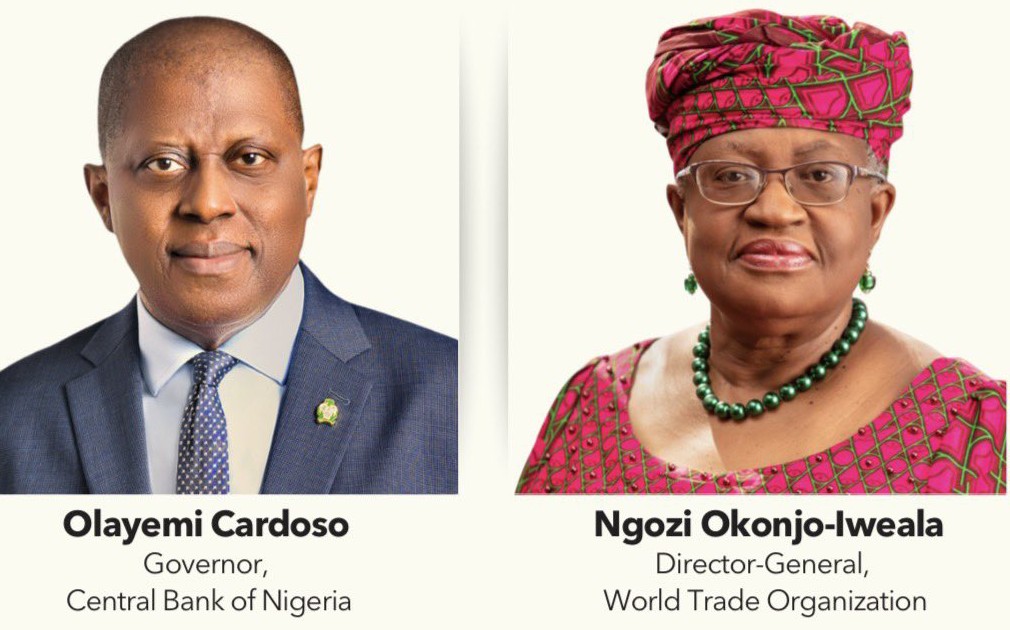
When the Central Bank of Nigeria (CBN) Governor, Olayemi Cardoso, sat down with the Director-General of the World Trade Organization (WTO), Dr Ngozi Okonjo-Iweala, for a fireside chat at the just-concluded 7th Africa Emerging Markets Forum in Abuja, the conversation quickly moved beyond ceremonial pleasantries into one of the most consequential questions facing Nigeria and the African continent today: how to pull together to trade, grow and prosper in a world that is pulling apart at the seams in an era growing multilateralism.
For nearly an hour, two of the continent’s most recognisable economic policymakers traded perspectives on issues, and at several points, tackled one another, on subjects ranging from the reconfiguration of global supply chains to the slow pace of intra-African trade, the mobilisation of domestic capital, and the leadership qualities required to convert Africa’s youthful population into a formidable economic asset rather than a liability.
The result was less a formal interview than an extended, candid conversation between two global citizens who, in different capacities, have each spent the past two years trying to restore credibility to institutions under considerable strain — Cardoso at the CBN back home, and Okonjo-Iweala the WTO on the global stage.
Fragmentation as Both Threat and Opportunity
The first salvo thrown by Cardoso hit straight at the heart of the forum’s theme: what does the reshaping of global trade architecture mean for an economy like Nigeria’s, built on assumptions of open, rules-based multilateral trade?
In return, Okonjo-Iweala’s response set the tone for much of what followed. Rather than dwelling solely on the risks of a fragmenting global order, the WTO DG urged policymakers to look for and discover the opportunities that the global crises tend to conceal.
Her argument centred on the idea that global supply chains have become dangerously concentrated in the hands of a few countries. The attendant disruptions of recent years, she noted, have exposed the costs of that concentration.
She pointed to the near-total reliance on Taiwan for semiconductor chips, the fact that a small cluster of countries produced the overwhelming majority of the world’s COVID-19 vaccines, and the concentration of critical mineral processing and rare-earth output in China as illustrations of an overdependence that both producers and consumers are now eager to correct.
That correction, she suggested, is prompting global manufacturers — from automobile makers to pharmaceutical firms — to diversify not just their suppliers, but the geography of their supply chains altogether.
Although she said diversification was where Africa’s survival lies, the WTO boss was careful not to suggest that the opportunity would simply present itself on a platter.
While competing regions, particularly in Latin America and Asia, are courting the same investment, she said Africa’s success would depend on whether it can get “its house in order”, by improving governance, infrastructure and the ease of doing business quickly enough to be competitive.
Crucially, Okonjo-Iweala argued that this should not be pursued as a series of uncoordinated bilateral deals between individual African countries and outside powers, which she warned could work against the continent’s collective interest.
Instead, she made the case for subregional value chains, citing the possibility of West African countries, including Nigeria and Ghana, jointly developing capacity that stretches from the processing of critical minerals used in renewable energy technologies all the way to the manufacture of electric vehicle batteries.
Nigeria’s Institutional Rebuilding
Turning the question back on his Cardoso, Okonjo-Iweala asked what Nigeria, and indeed Africa more broadly, should be doing at this moment.
In providing an answer to the power, Cardoso leaned heavily on the CBN’s own experience over the past two years as a case study in institutional rebuilding.
He recounted a period in which the bank’s foreign reserves had fallen to an all-time low level, inflation climbed, and confidence in the institution and the broader economy eroded to the point where neither foreign investors nor Nigerians themselves had much appetite to stay invested.
He said the apex Bank’s interventions involved making its processes more transparent, ensuring policy consistency rather than the flip-flopping that had previously undermined credibility, and being willing to publicly acknowledge when course corrections were needed.
Also, he pointed to difficult decisions taken in the foreign exchange market and the banking sector as central to the turnaround, framing the entire effort as a long journey, rather than a short-term fix.
Okonjo-Iweala welcomed the CBN’s progress but pressed further, noting that the real test lies in whether ordinary Nigerians can feel the benefits of macroeconomic stabilisation in their daily lives.
Drawing a parallel to her own experience overseeing economic reforms, she argued that public support for difficult policy choices depends on people seeing tangible improvements — jobs, growth, opportunity — rather than simply hearing that the numbers have improved.
She cited the roughly 6 percent annual growth rate Nigeria’s economy achieved during an earlier period of reform, and the job creation that came with it, as evidence that credible reform can translate into broad-based gains, provided the fiscal side of government moves in step with the monetary side.
On that point, Cardoso offered what may be one of the more institutionally significant details to emerge from the conversation, describing recent efforts to formalise coordination between fiscal and monetary authorities; the overlapping representation between the CBN’s Monetary Policy Committee, and Board of the Bank on one hand, and the offices of the Accountant-General and the Permanent Secretary in the Federal Ministry of Finance on the other.
He framed this as evidence that collaboration between the two arms of economic management was no longer aspirational, but structurally embedded — a claim that would likely be tested in the months ahead as fiscal and monetary policy continue to be assessed jointly by markets and citizens alike.
The AfCFTA Test
If there was a single thread running through much of the exchanges, it was the topic on African Continental Free Trade Area (AfCFTA), which Okonjo-Iweala described as one of the most powerful instruments available to the continent’s growth.
Nigeria, she noted, currently holds the chairmanship of the initiative, under Trade Minister, Jumoke Oduwole, with a particular emphasis this year on advancing digital trade provisions.
Her challenge to Cardoso, and by extension to Nigerian and African policymakers more broadly, was blunt: why should intra-African trade remain stuck at roughly a fifth of the continent’s total trade, when trade among European Union members sits at around three times that level?
She did not argue that Africa needed to match Europe’s figure, but suggested that even doubling intra-African trade over five to six years would represent meaningful progress that will not happen passively, but deliberately driven by policy and infrastructure choices.
Cardoso’s response pointed to what he described as a shift in tone among the region’s policymakers, driven in part by the recognition that external conditions no longer afford African economies the luxury of slow-moving cooperation.
The CBN governor recalled a period when the Naira was viewed with scepticism elsewhere on the continent, contrasting it with what he characterised as strengthening momentum today, including renewed, if still preliminary, discussions around a common currency arrangement for West Africa.
His broader point was that talk of collaboration must translate into execution — bringing down barriers where feasible and moving past what he called “nice conversations” that fail to produce results.
Mobilising Domestic Capital
A recurring decimal in the conversation was the idea that Africa can no longer rely on the flow of external resources — aid, concessional financing, foreign direct investment — at the levels it once did, as donor countries redirect spending toward domestic priorities including defence.
Both speakers agreed that this makes domestic resource mobilisation not merely desirable, but unavoidable.
Cardoso cited the CBN’s recent bank recapitalisation exercise that ended with nearly N5 trillion raised, roughly three-quarters coming from domestic sources, rather than foreign investors, a figure he offered as evidence that Nigerian capital markets can be mobilised at scale when the incentives are right.
Okonjo-Iweala went further to point to the significant amounts of cash she said remain outside the formal financial system informally described as money “hidden under mattresses” — and visible, in her telling, in the scale of private construction activity underway in Abuja.
Her argument was that attracting foreign investment was difficult when a country’s own investors lack confidence in it, and that building that domestic confidence should be a precondition, not an afterthought, in the broader push for growth.
The Demographic Question
The exchange also turned to Africa’s demographic profile, where Okonjo-Iweala noted that the bulk of a population approaching 1.5 billion was under 30.
She observed that the challenge posed by a growing population without deliberate action on jobs, skills and opportunity was becoming a burden and demographic weight risks rather than the dividend it is often described as.
Cardoso described how rapid population growth in a city with a small landmass, combined with sluggish economic expansion to create a “ticking time bomb” that require an urgent investment in infrastructure development, in order to buy time for more fundamental reforms.
Transparent Leadership as the Final Word
Asked what success might look like for Africa a decade from now, Okonjo-Iweala did not point to a growth target or a trade statistic.
Rather she did not mince words pointing at leadership, saying specifically that leaders who prioritise national and continental interest over self-interest, who govern transparently, and who focus on implementation rather than rhetoric.
She clarified that she was not demanding perfection, suggesting that leadership performing at even three-quarters of its potential would meaningfully change the continent’s trajectory.
Her vision of success was one in which young Africans no longer feel compelled to risk perilous journeys abroad in search of opportunity, and in which women — whom she described as natural multitaskers deserving of greater opportunity — are more fully integrated into economic life.
What the Exchange Signals
Taken together, the conversation offered a rare, unscripted window into how two of Africa’s most prominent economic figures are thinking about the continent’s position in a fracturing global order.
Neither offered easy answers. Both, notably, converged on a similar diagnosis: that the era of relying on external goodwill — whether in the form of aid, open markets, or patient capital — was fast ending, and that Africa’s growth, if it is to come, will have to be self-generated, through deeper intra-African trade, mobilised domestic savings, and institutions capable of sustaining credibility over time.
For Nigeria in particular, the stakes are framed as larger than its own borders. Okonjo-Iweala’s reminder that the country accounts for a substantial share of West Africa’s economic output, and a significant portion of Sub-Saharan Africa’s, was less a compliment than a challenge: get economic management right, and the effects ripple across the region; get it wrong, and the costs are similarly shared.
Whether the coordination between Nigeria’s fiscal and monetary authorities, the momentum behind AfCFTA under Nigeria’s chairmanship, and the renewed emphasis on domestic capital mobilisation can be sustained beyond the forum’s closing remarks remains, as both speakers acknowledged, a matter of execution — not conversation.

