
By Bassey Udo

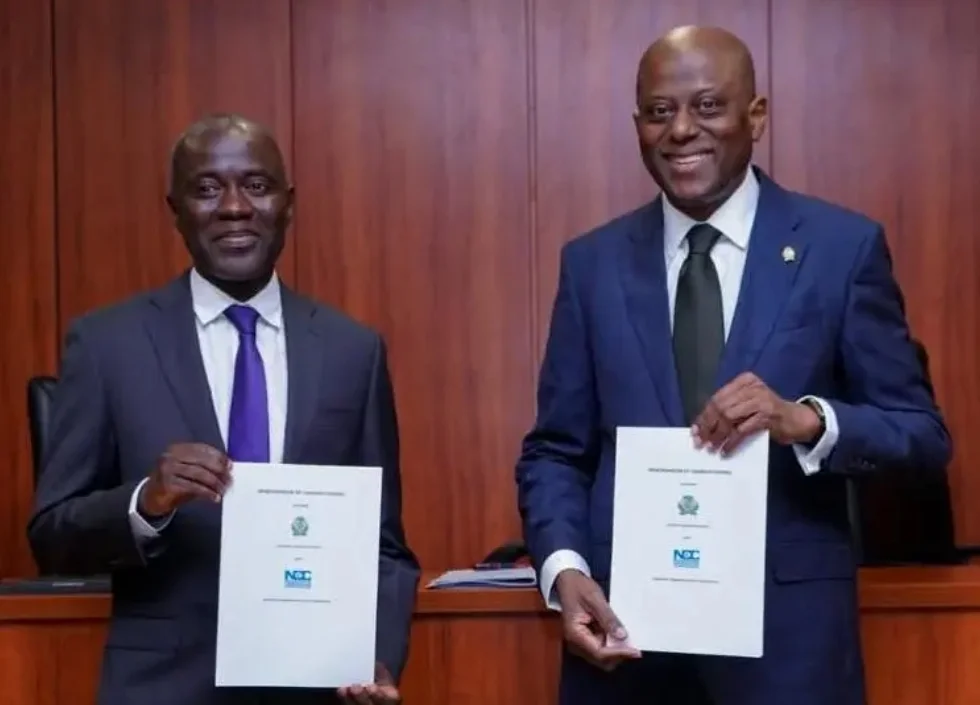
The Central Bank of Nigeria (CBN) on Monday agreed to collaborate with the Nigerian Communications Commission (NCC) to establish a framework to curb the rising incidence of sophisticated fraud schemes in the financial system as a result of the introduction of digital and electronic payment methods in the country.
At the formal signing of a memorandum of understanding (MoU) in Abuja, the CBN Governor, Olayemi Cardoso, said the collaboration would help improve coordination by the two regulatory bodies in the financial and telecommunications sectors, by focusing on combating electronic frauds linked to the use of mobile phone numbers, enhancing payment system integrity, protecting consumers and enabling financial system stability.
Acknowledging the financial and communications sectors as central in the heart of the country’s economy, Cardoso said across the country today, Nigerians and businesses are increasingly dependent on digital channels to save, pay, trade, access credit, and build livelihoods.
In turn, those channels, he said, depend on resilient telecommunications networks, trusted identity systems, and secure data flows to function.
“When the communications sector is strong, the financial system is more inclusive and more efficient; and when the financial system is sound, investment and innovation in the digital economy can thrive. That is why this MoU is not merely an administrative document—it is a practical statement of national interest,” he said.
With the scale and complexity of today’s digital financial ecosystem, the CBN governor said it requires a more comprehensive, forward-looking, and enduring framework for payment service providers, coordination to support cross-platform stability, and the resolution of challenges around USSD payments.
He said the MoU would not only provide the operational framework, but would also reinforce the stability and integrity of Nigeria’s payment system.
“As we deepen instant payments, expand QR-based payments, and advance open banking and API interoperability, it is essential that infrastructure across both sectors is aligned—so that transactions are reliable, services scale smoothly, and consumers enjoy safe and seamless experiences. Through this MoU, we will strengthen coordination on approvals, technical standards, and innovation trials, including sandbox testing that supports market-led solutions while safeguarding stability,” he said.
Besides, he said the MoU would help strengthen the collective response of the CBN and NCC to electronic fraud and improve consumer protection as a result of the rise in digital applications, which have also attracted increasingly sophisticated fraud schemes.
Under the MoU, he said the two agencies would be able to support measures to strengthen authentication for higher-risk transactions, ensure effective transaction monitoring, functional fraud reporting channels, and a harmonised consumer sensitisation programme—particularly for underserved segments and micro, small and medium enterprises (MSMEs) that are often most exposed to these risks.
Also, he said the MoU would support the implementation of the Telecom Identity Risk Management Portal (TIRMP)—a secure, regulatory-backed data-sharing platform designed to help prevent fraud linked to churned, swapped, or blacklisted mobile numbers.
The ability to verify mobile number status in real time across banks, fintechs, and other digital platforms, he pointed out, is a critical layer of protection for consumers and for the financial system.
With the MoU, he said, the use of verified mobile phones would be governed by clear standard operating guidelines and strict compliance with Nigeria’s data protection requirements, including appropriate safeguards, encryption, and consent protocols.
In his remarks, the Executive Vice Chairman/CEO of the NCC, Dr Aminu Mada, described the MoU as an important milestone that reflects a shared commitment to collaborate and strengthen financial system stability, advance digital inclusion, and
protect consumers in an increasingly interconnected ecosystem.
Working collaboratively with the CBN, he noted, was an imperative, as their regulatory roles have made them to become deeply interdependent,
collectively shaping virtually every aspect of lives in the economy.
He said the MoU was an imperative for CBN and NCC to work together in the best interest of the Nigerian consumer, as it reflects their shared commitment to building a stronger digital economy that is trusted not only by the Nigerian people, but also by the global business community.
“This MoU provides a clear framework for cooperation in critical areas such as payment system integrity, consumer protection, fraud mitigation, and the responsible use of digital infrastructure. In particular, it supports initiatives that promote secure digital payments,
enhance trust in mobile-enabled financial services, and extend safe access to underserved populations and MSMEs,” he said.
He said as mobile numbers increasingly underpin identity, authentication, and financial access, collaboration with the CBN was essential to ensure that innovation was matched with
strong governance, system stability, and consumer safeguards.
Apart from the prevention of electronic fraud, which has become increasingly pervasive, with significant implications for the integrity of the digital economy, he said through the Telecom Identity
Risk Management System (TIRMS) Portal—which aggregates data on churned (recycled) phone numbers, as well as numbers flagged within the financial sector, financial services
would now have enhanced visibility into the status of phone numbers, which is one of the most widely utilized resources in financial sector.
With the new framework, the NCC boss said financial institutions would now be able to determine when a line is active, when it has been swapped, when it has been disconnected due to inactivity and reassigned to a new subscriber, and when it has been flagged for suspicious or fraudulent activity.
This, he said, would ensure that financial services industry was better equipped with timely and relevant information to effectively combat e-fraud, particularly those perpetuated using phone
numbers in the country.
Earlier, the Director of Payment System Supervision at the CBN, Dr Rakiya Yusuf, said the collaboration between both regulatory bodies was a culmination of years of exercising different oversight roles focused on securing Nigeria’s digital and financial systems.
She said the collaboration between CBN and NCC dated back to earlier efforts to align mobile payment regulations and telecom licensing frameworks, including the 2018 MoU that enabled telecom operators to participate in mobile money services through special purpose vehicles.
During the event, two joint committees on Payment System and Consumer Protection as well as on Telecom Identity Risk Management System (TIRMS) were inaugurated to provide structured coordination, resolve operational frictions, recommend improvements, and regularly report progress.

