
By Bassey Udo in Brussels, Belgium

Nigeria has reaffirmed its commitment to the principles and Standard of the global Extractive Industries Transparency Initiative (EITI), pledging to strengthen public disclosure, revenue reconciliation, independent audits and institutional accountability across its extractive sector.
Also, the Federal Government told the global community how the country utilized the annual audit reports by the Nigerian Extractive Industries Transparency Initiative (NEITI) to recover billions of Naira from some operating companies and agencies back into the national treasury.
The commitments were made on behalf of the government by the Minister of State for Petroleum Resources (Gas), Ekperikpe Ekpo, who delivered a speech on behalf of President Bola Tinubu during the Leadership Forum at the ongoing 10th EITI Conference in Brussels on Thursday.
Ekpo expressed Nigeria’s appreciation for the opportunity offered by the conference to participate in the important global conversation on transparency, accountability and responsible governance of natural resources.
He recalled that after Nigeria joined the EITI in 2003, it proceeded to domesticate the EITI standards and principles in the operations of its extractive industries in 2004, followed by its commitment to institutionalize the process through the enactment of the NEITI Act 2007, which provided a statutory framework for promoting transparency and accountability in managing extractive resources.
Since then, the Minister said the EITI principles have become increasingly embedded in Nigeria’s legal and institutional framework, particularly in the management of revenues serviced from the exploitation of the extractive industries resources.
Citing the enactment of the Petroleum Industry Act (PIA) 2021, he said its provisions have regulated and demanded greater disclosure across the petroleum value chain, including public registers of petroleum licences and leases and disclosure of beneficial ownership information.
“These provisions demonstrate that Nigeria’s commitment to transparency is not simply a policy declaration; it is increasingly reflected in our laws, institutions and regulatory processes,” the minister said.
NEITI’s work, he added, complements this framework through independent annual audits, revenue and production disclosures, validation and stakeholder engagement.
This, he noted, has enabled government, industry, civil society and citizens to better understand how revenues from natural resources flow and to hold institutions accountable.
Recently, he said the government, through the provisions of Executive Order 9 and revenue reforms, undertook significant reforms which, though broader than EITI implementation, directly support its core objectives of transparency, accountability, and efficient revenue management to generate public value.
Executive Order 9 of 2026, he explained, addresses certain deductions and arrangements affecting Federation revenues, while the reforms were meant to deliver more than immediate fiscal gains as part of a broader effort to strengthen institutions, improve regulatory clarity, reduce leakages, enhance investor confidence and ensure that value from natural resources translates into national development.
The Minister reaffirmed the Nigerian government’s commitment to strengthening the traceability and oversight of petroleum revenues by directing their remittances into the Federation Account and improving the reconciliation, reporting and management of revenue flows.
“For Nigeria, this is both a fiscal and a transparency reform by creating a clearer pathway from petroleum production through revenue collection and remittance to appropriation,” he said.
He stressed that sustaining these gains would require a strong legal and regulatory framework, reliable data systems, independent audits, public disclosure and continuous stakeholder engagement.
Nigeria, he reassured, would continue to strengthen NEITI and the other institutions responsible for accountable governance in the extractive industries sector.
“Transparency must not be an end in itself,” Ekpo told delegates. “It must enable accountability; accountability must strengthen governance; and good governance must ultimately translate into shared prosperity.”
The minister said Nigeria commits to making petroleum revenues more traceable, reducing leakages and helping citizens see more clearly how resource revenues support national development.
As a mark of accountability, he announced that by the end of 2027 Nigeria will publish a progress update setting out the reforms implemented and the measurable improvements achieved.
“Through these measures, Nigeria seeks to build greater public trust, strengthen the economy and ensure that the responsible and transparent management of its natural resources delivers lasting value” to present and future generations, he said.
, the
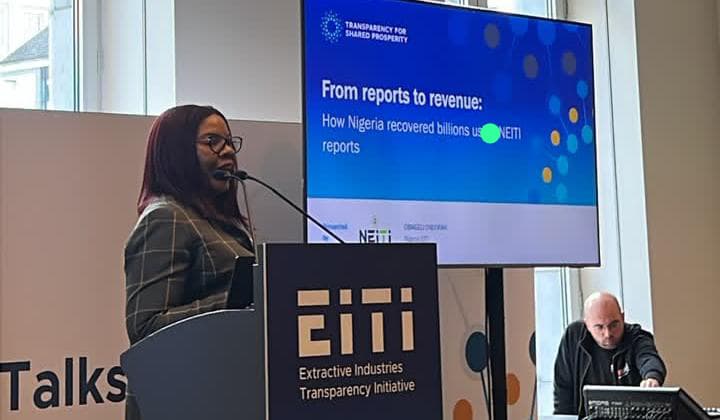
During the session on “Innovation Talks: Turning extractive data into accountability, participation and better decisions”, the Director of Communication and Stakeholders Management at the Nigeria Extractive Industries Transparency Initiative (NEITI), Obiageli Onuorah, presented the country’s experience on the topic: “From reports to revenue: How Nigeria recovered billions using NEITI report.”
In her presentation, Onuorah described how audit findings that once went unacted upon became a tool for recovery of several billions of Naira in extractive industries revenue deployed into the provision of essential amenities for the benefit of the people.
“Can you imagine misplacing money?” she asked delegates in her opening remarks, describing not a forgotten banknote, but billions of dollars in plain sight yet not found.
For years, she said, Nigeria lost large sums in its extractive industries, not for lack of care, but because critical information that was publicly available was not acted upon by the government.
She explained that when Nigeria joined the EITI in 2003 and began implementation of the principles and standards of the global transparency group in 2004, the country had three objectives, namely to disclose information about the extractive industry; mobilise stakeholders, including companies, government and civil society, to use that information to hold covered entities accountable, and to use that mobilisation to drive regulatory reforms in the extractive sector.
After producing 35 cycles of audit reports, 16 of them in the oil and gas sector, covering 1999 to 2023, Onuoarah said the NEITI reports uncovered massive irregularities, systemic issues and weaknesses.
Rather than stop at the publication of the reports. Onuorah said NEITI utilized the contents of the reports and findings as intelligence to mobilise stakeholders, including civil society and the media, to drive the reforms that pressurized the government to take action by setting up adhoc committees to look at the report.
Besides, she said the National Assembly was also engaged, resulting in committees set up to examine the details of the findings and recommendations in the reports.
Government agencies, she said, were pushed to action, while the media and civil society amplified the findings, and anti-corruption agencies urged to investigate further on the issues identified in the reports.
The result, she said, was that billions of Naira that had been overlooked, which forced the government to borrow to fund development projects, were recovered from defaulting companies and paid into the treasury.
Onuorah illustrated the scale with NEITI’s data on outstanding liabilities for unremitted revenues relative to the national budget.
In the 2019 NEITI Audit report, she noted, about $6.48 billion, or over one-fifth of the country’s annual budget, had not been remitted to the government treasury by various operators in the sector.
“These figures look like numbers, but these are actually numbers that affect people’s lives, in terms of revenue shortfalls meant for infrastructure that could not be upgraded, classrooms that stayed overcrowded and hospitals that lacked proper equipment for the benefit of the people.
“They also meant the government would keep borrowing to fund budget deficits, sometimes for the critical infrastructure citizens need”, she explained.
From the 2019 figure of $6.48 billion, she said, over 50 per cent has been recovered into the treasury through the follow-up on NEITI reports by the various government agencies.
She said the recovered revenues, which constitute about 22 per cent of the total government budget, could fully fund power, works and transport, defence and security, and health budgets.
