

Despite a marginal 4 percent decline in production due to challenges in key offshore oil fields operations, Nigeria’s oil and condensate output since March this year has maintained a consistent climb above quota levels set by the Organization of Petroleum Exporting Countries (OPEC), latest operations data from the Nigerian Upstream Petroleum Regulatory Commission (NUPRC) have shown.
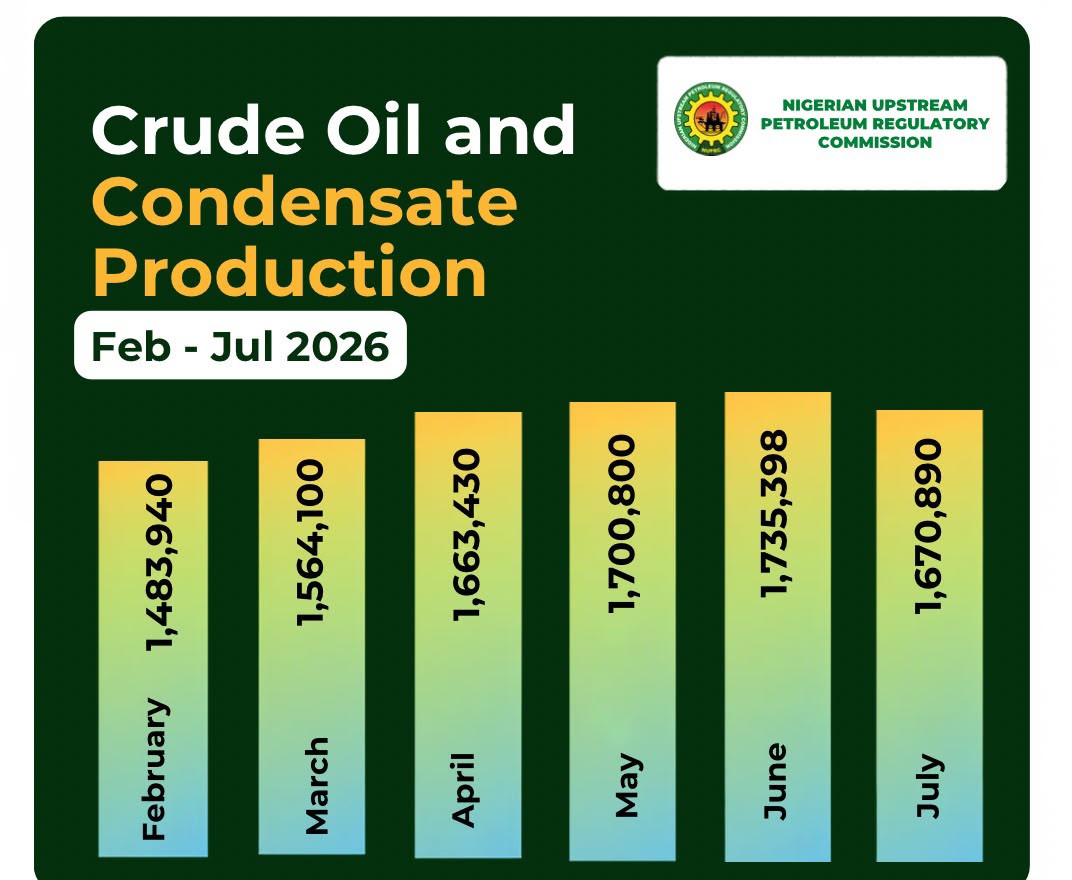

In March, output grew from about 1.484m barrels per day in February above the approved OPEC Quota level of an average 1.5m barrels per day to about 1.564million barrels, before a further increase to 1.663m barrels in April.
Also, in May, the figure climbed again to 1.7m barrels and 1.735m barrels in June, before a slight decline to 1.67m barrels.
The output average between the lowest (1.57m) and peak (1.78m) daily crude oil and condensate production levels was about 1.67m barrels, consisting of 1.505m barrels per day for oil and 0.17m barrels per day of condensate.
A breakdown of the daily average crude oil and condensate production by terminals/streams during the review month shows that Forcados Terminal accounted for 322.34k barrels per day (bpd); Bonny Terminal accounted for 303.72kbpd, while Qua Iboe Terminal recorded an average production of 158.02kbpd of crude oil and condensates, and Escravos Oil Terminal posted a daily average of 131.41kbpd.
Bonga, which ranks as the fifth highest producing terminal, recorded an average of 100.23kbpd of crude oil.
Although on a month on month basis output fell by about 4 percent in July, the datat showed that the level was still above the OPEC Quota level of an average of 1.5m barrels per day.
The NUPRC attributed the slight decline in output level to operational challenges reported at two key deep offshore oil fields – Erha and Akpo, which impacted production output during the period under review.
The NUPRC said these disruptions constrained oil production volumes and contributed significantly to the overall reduction in national crude oil output for the period.
“Despite the challenges, production operations across most other producing assets remained relatively stable, with operators implementing measures aimed at maintaining production efficiency and minimizing the impact of operational constraints,” NUPRC said.
The Commission said routine production activities and crude evacuation operations were largely sustained across the sector, with industry stakeholders focused on addressing the identified operational issues, restoring affected production capacity and strengthening asset reliability to support improved performance in subsequent months.
The upstream petroleum industry regulator said the July outcome underscores the importance of proactive asset management, operational resilience, and timely intervention in mitigating production disruptions within the Nigerian upstream petroleum industry.

