
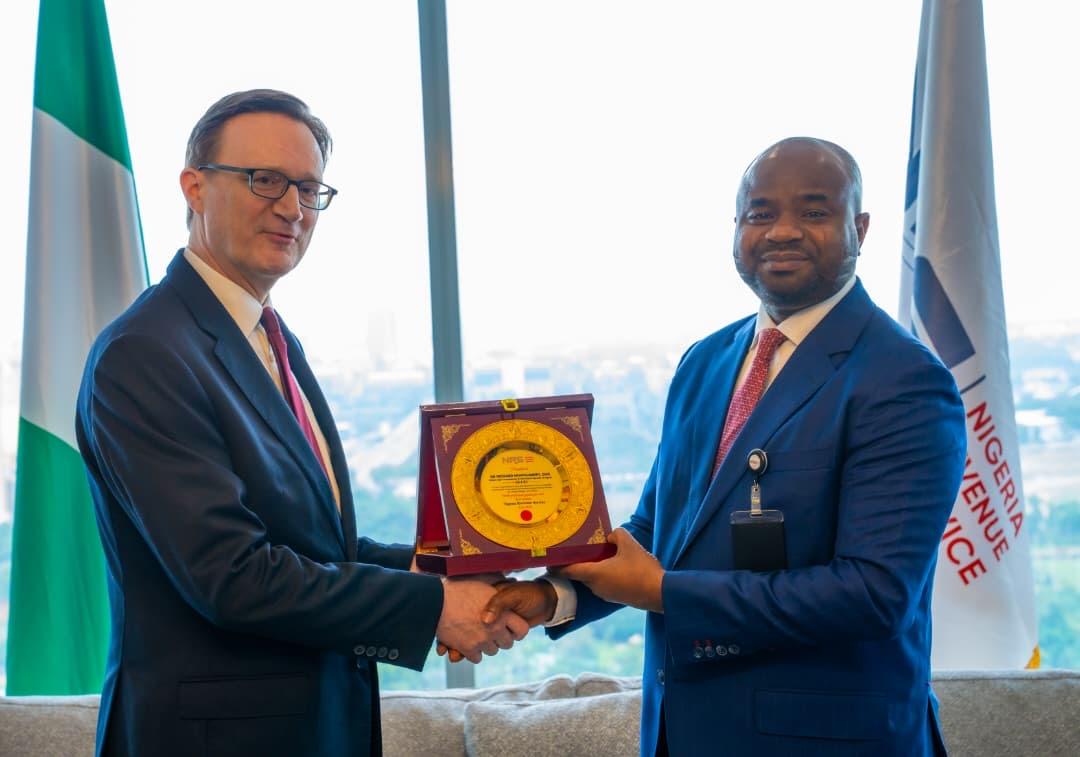
Picture Caption: L-R: Outgoing British High Commissioner to Nigeria, Richard Montgomery, with the Executive Chairman of the Nigeria Revenue Service (NRS), Dr Zacch Adedeji, during Montgomery’s farewell visit to the NRS new headquarters in Abuja, on Tuesday.

Outgoing British High Commissioner to Nigeria, Richard Montgomery, on Tuesday expressed optimism that President Bola Tinubu’s economic reforms would put the country on a stronger footing in the long term, even as he acknowledged the short-term hardship they have caused ordinary Nigerians.
Montgomery spoke during a farewell visit to the Nigeria Revenue Service (NRS) headquarters in Abuja.
A statement by Dare Adekanmbi, who is the Special Adviser to the NRS Executive Chairman, Dr Zacch Adedeji, said the envoy described his three years in Nigeria as a period marked by significant positive change within which he said was “awesome” to have witnessed so much progress.
Although he conceded that economic reforms such as currency devaluation had resulted in rising inflation that inflicted real pain on ordinary citizens, he insisted they were necessary steps toward the country’s economic recovery.
Montgomery said he had briefed —and would continue to brief -UK officials, including incoming Prime Minister, Andy Burnham, who is expected to speak with President Tinubu in the coming weeks, on the significance of Nigeria’s reform agenda.
He credited the monetary policy work of Central Bank of Nigeria Governor, Olayemi Cardoso and former Finance Minister and Coordinating Minister for the Economy, Wale Edun, as well as the tax and fiscal reforms driven by Adedeji and Taiwo Oyedele, now Minister of Finance and Coordinating Minister of the Economy.
He acknowledged the complexity of Nigeria’s fiscal landscape, particularly the challenges of budget management within the National Assembly, and praised the finance team for improving the country’s financial management despite these constraints.
Montgomery said he admired not only the technical competence of Nigeria’s economic team, but also their political skill in navigating driving the reform.
He also pointed to other achievements during his tenure, including leadership changes at the Nigerian National Petroleum Company (NNPC) Limited, increased investment inflows, and improved credit ratings, describing the broader economic management team’s work as foundational to Nigeria’s economic future.
Looking ahead, Montgomery said he had privately urged Nigerian officials to focus on raising the growth rate from 4 to 7 percent over the next four years, calling this the key to improving living standards for ordinary Nigerians.
He expressed confidence that, with continued collaborative effort, this goal was achievable.
Montgomery who praised the NRS as one of the UK’s strongest partners in Nigeria, commended Adedeji’s leadership and highlighted the collaboration between the NRS and Britain’s HM Revenue and Customs on peer review processes.
In his response, Adedeji said it was bittersweet to see Montgomery depart Nigeria at this juncture, praising the outgoing envoy’s dedication and commitment to a better future for the country.
He said Montgomery’s personal engagement and technical support had helped reshape Nigeria’s reform story, particularly given the uncertainty that surrounded the reforms early on.
“That support is not lost on us,” Adedeji said, expressing gratitude for Montgomery’s commitment, noting that he was leaving at a time when the reforms’ benefits were becoming visible.
He credited Montgomery’s engagement with helping shape the reform process, echoing the envoy’s view that sustainable development stems from strategic partnership rather than aid, adding that he expected that spirit of cooperation to continue under Montgomery’s successor.

