

By Bassey Udo

Amid two consecutive marginal increases in inflation rate, the Central Bank of Nigeria (CBN) decided to keep the controlling lending for commercial banks unchanged at 26.5 percent, along with other monetary policy parameters.
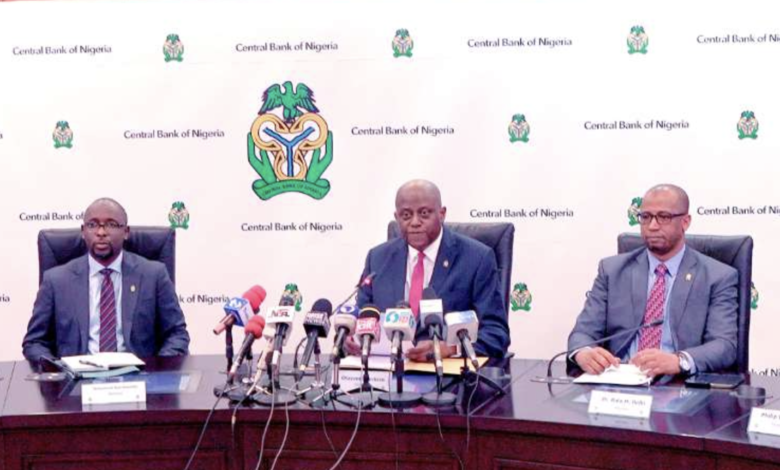
The CBN Governor, Mr Olayemi Cardoso, who disclosed this at the post-Monetary Policy Committee (MPC) meeting in Abuja on Wednesday, said lendings by Deposit Money Banks DMBs) and Development Finance Institutions (DFIs) to Nigeria’s Small and Medium Enterprises (SMEs) grossed in excess of N199billion in April 2026, compared to N153 billion in March 2026.
Mr Cardoso said other key resolutions during the meeting included the retention of the Cash Reserve Ratio (CRR) at 45% for Commercial Banks; 16% for Merchant Banks, and 75% for non-Treasury Single Account public sector deposits, and Retained Standing Facilities Corridor at +50/ -450 basis points around the monetary policy rate (MPR).
Mr Cardoso said 11 members of the MPC in unanimously vote anchored their resolution on a comprehensive assessment of the prevailing risks in the economy to the overall outlook.
Although the Committee noted the marginal rise in inflation for two consecutive months, largely as a result of external shocks, mainly from the continued conflict in the Middle East, the apex bank governor said with its transitory nature, he was confident that the current macroeconomic environment was sufficiently robust to support a return to disinflation.
“In reaching its decisions, the MPC particularly noted the spillovers from the Middle East crisis, which have exerted upward pressure on energy prices, cost of transportation and other logistics.
“However, available evidence indicates that the impact of the crisis on the Nigerian economy has been largely muted due to the benefits of prior policy reforms, including exchange rate stability, improvements in external reserve buffers, strengthened monetary policy transmission, well-capitalised banking system, and ongoing fiscal consolidation, which have significantly bolstered the economy’s ability to absorb external shocks.”
Consequently, he said the impact of global commodity and energy price shocks to domestic inflation has been significantly mitigated with ongoing reforms, adding that the MPC was convinced that the essential conditions for price stability remained firmly in place..
With the country’s external reserves at $49.49 billion as of May 15, 2026, from a $48.35 billion in March, the CBN Governor said the economy was strong and resilient, as current reserves position was sufficient to provide 9.04 months import cover for goods and services as well as reinforce investor confidence and support for exchange rate stability.
Mr Cardoso, who acknowledged the surge in Headline inflation from 15.38% in March 2026 to 15.69% in April 2026, said this was driven primarily by food prices, which climbed to 16.06%, from the 14.31% recorded over the same period.
The Committee, which attributed the rising food prices to the corresponding hike in transportation and logistics costs due to the ongoing Middle East conflict, noted the nation’s strengthening economic position, with real gross domestic product (GDP) expanding by 4.07% in the fourth quarter of 2025, from 3.98% recorded in the previous quarter.
He said the growth in the aggregate value of goods and services in the economy for the period was supported by significant gains in agriculture, industry, and services sectors, particularly information and communication technology.
Besides, the MPC noted the impact of the oil sector growth, which accelerated from 5.84% in the third quarter of 2025 to 6.79% boosted by improvements in downstream petroleum industry refining capacity.

Celebrating the recent successful conclusion of the banking sector recapitalisation exercise, which produced 33 banks with stronger balance sheets, the MPC urged the apex bank to remain alert to post-recapitalisation risks by taking proactive measures to continue safeguarding financial system stability.
Pointing at the country’s recent sovereign rating upgrade as further validation of the impact of the reforms, despite global headwinds, including geopolitical tensions in the Middle East resulting in energy market disruptions, and tighter economic conditions in advanced economies beclouding the external environment, the MPC said the expectation was for output growth to remain resilient in 2026.
However, it said the growth was projected to moderate near-term increase in inflation before a return to a sustained disinflation path, supported by the previous monetary tightening, exchange rate stability, and improved food supply.
Reviewing the performances of some key sectors of the economy, Mr Cardoso
He said the increasing channeling of credit lending to SMEs was not an exclusive reserve of the central bank, as available data from the retail end of the market showed increased credit facilities toward SMEs from DMBs.
“It’s not an exclusive reserve of the Central Bank. It’s something that is done in collaboration with different arms of government. And that’s why you have the Ministry of Industry, Trade and Investment, Bank of Industry (BOI) and fiscal interventions from time to time in certain sectors we believe are necessary to ensure that those who need to be given the impetus, and in some cases protection are done so,” the CBN governor explained.
He said the Central Bank, which sees itself as a catalyst, has deployed its convening power by using some of the tools at its disposal to ensure the banks encouraged those who previously may have shied away from dealing with SMEs to do so.
“From what we’ve seen of recent, the volume of new credits going to the SME sector have increased. This can be attributed to various things, including that many of the commercial banks are recalibrating and looking at the future to see how to diversify their lending base,” he said.
With lending remaining heavily skewed towards the general category, which accounted for about 94.73% of new credit facilities, and general commerce about 2.46%, he said this reinforces the dominance of the SMEs sector, and short-term facilities.
“What is clear in this, he pointed out, is that banks are now willing to diversify their credit exposure at this time”, Cardoso said, adding that he was optimistic that this would continue.
On efforts to de-bottleneck dealings with SMEs,Mr Cardoso said the recent MOU signed by the CBN with NCC was driven largely by the need to make the process easier, particularly with respect to fraud and ability to connect properly into various systems to transact business.
In line with this, he said the bank have upgraded the obligor limit for DFIs, aimed at removing the constraints and expanding credit lending to SMEs sector,
“This is all work in progress. We’re not there yet. But all I can say is that the willingness to ensure that more credits are directed at the SME sector is certainly increasing”, he said.
With respect to incessant bank charges alert, with specific reference to N50k stamp duty charged by banks, Mr Cardoso explained that stamp duty charge was not a banking sector affair, assuring that the consumer protection department of the CBN was doing a lot to protect customers against unfair charges by the banks.
He said the charges were emanating from the tax authorities, with the banks as a channel to ensure the money gets to the final destination.
While encouraging bank customers to liaise with their banks to resolve issues of excessive charges, the CBN governor aggrieved persons could escalate the issue to the apex bank by approaching its consumer protection department, consisting representatives of the various deposit money banks and the top ten microfinance banks during their quarterly meetings to look at concerns about services from the financial system.

