By Bassey Udo

Importation of petroleum products, particularly premium motor spirit (PMS), popularly called petrol, remain high, even as Dangote Refinery & Petrochemicals Limited (DRPL) record increased supply capacity in December 2025, a Fact Sheet on the state of the midstream/downstream sector of the petroleum industry has shown.
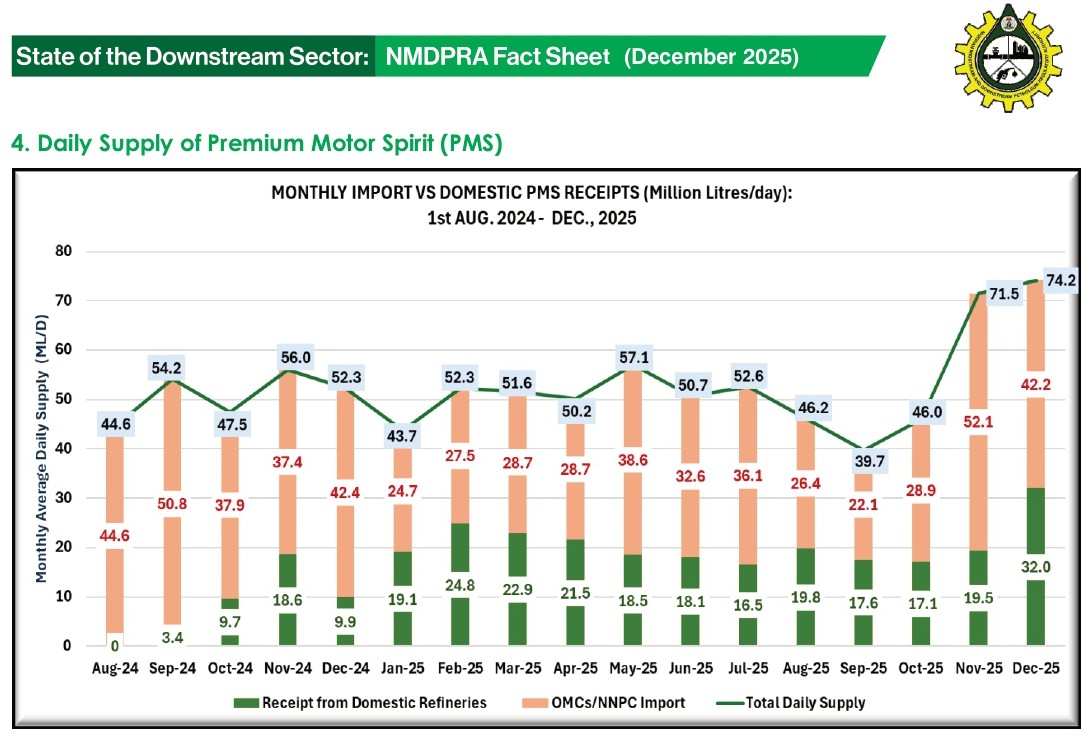
The Fact Sheet published by the sector regulator, the Nigeria Midstream and Downstream Petroleum Regulatory Authority (NMDPRA) for December 2025 showed that out of the total volume of 74.2 million litres per day of PMS supplied for the month, the Nigerian National Petroleum Company (NNPC) Limited and other undisclosed oil marketing companies accounted for 42.2 million litres per day from imports (about 56.87 percent), against 32.01 million litres per day, or 43.14 percent, supplied by Dangote Refinery alone.
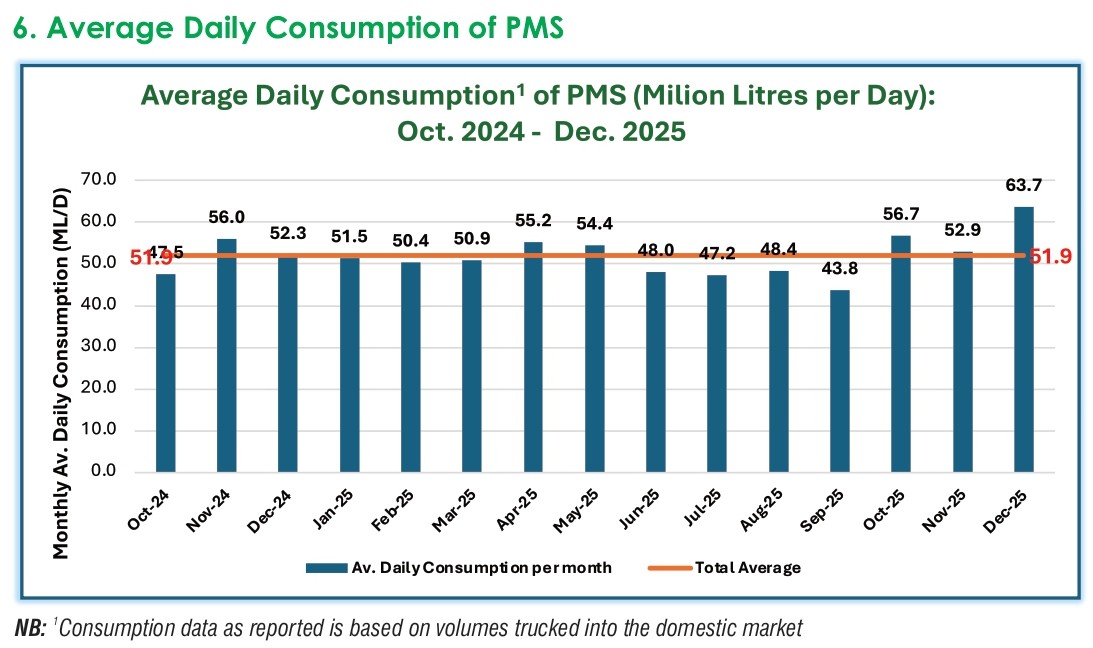
The 74.2 million litres of petrol supplied during the month exceeded by 24.2 million litres the 50 million litres daily consumption benchmark by the NMDPRA for 2025.
The agency gave the average daily consumption of petrol between October 2024 and December 2025 at 51.9 million litres per day.
Other daily products consumption benchmarks by the NMDPRA included AGO (diesel) put at 14 million litres per day; Aviation fuel (ATK) 3 million litres per day and Liquefied Petroleum Gas (LPG) or cooking gas 3,900 Metric tons per day.
Although the latest PMS import figure dropped from 52.1 million litres per day out of a total volume of 71.5 million litres per day in November 2025, the volume of petrol supply from domestic sources in December rose significantly from about 19.5 million litres per day.
The latest petrol supply figure from domestic sources is the highest since February 2025 when about 24.8 million litres of petrol was supplied by the Dangote Refinery, which commenced the business of local refining operations in September 2024 with initial capacity of 3.4 million litres per day.
Petrol imports, which reached 52.1 million litres per day last November, maintained an average supply level of 35.39 million litres since August 2024, with the average national consumption level rising from 52.3 million litres per day in December 2024 to 63.7 million litres per day in December 2025.
 Data on the daily consumption based on the volumes of key petroleum products trucked out of the depots into the domestic market showed that PMS was 63.7 million litres per day; AGO (diesel) 16,4 million litrs per day; ATK (aviation fuel) 2.7 million litres per day and LPG (cooking gas) 4.380 MT per day.
Specifically, Dangote Refinery remains the sole supplier of petroleum products from domestic sources, with other licensed refinery operators at various stages of their construction.
The 5,000 barrels per day capacity Waltersmith Refinery only recently completed pre-commissioning of the construction of Train 2 of the plant ahead of its planned introduction of hydrocarbon scheduled for later this month.
The supply of petroleum products is not coming from any of the four state-owned refineries in Port Harcourt, Warri and Kaduna as no fuel production activities are currently ongoing at any of plants, as they remain shut down.
An update on the performance of the existing modular refineries highlighted in the Fact Sheet showed that Waltersmith Refinery, which was on production for only 13 days in December 2025 due to pre-commissioning of Train 2, currently has average capacity utilization of 63.24 percent, while Edo Refinery has average utilization capacity of 85.43 percent, and Aradel 53.89 percent. OPAC and Duport Refineries are not yet on production.
Further details on the performance of the Dangote Refinery during the month, the fact sheet revealed, was that the company’s average capacity currently stands at 62.94 percent, with plan to raise its domestic supply capacity from the current figure of 32.012 million litres to 50 million litres per day.
In terms of the domestic supply of automative gas oil (AGO), also known as diesel, the report said the 17.9 million litres per day recorded during the month actually dropped from 20.4 million litres in November 2025, with actual average domestic supply of AGO put at 5.783 million litres per day.