


By Bassey Udo

Building strategic partnerships between the National Assembly and key institutions like the Fiscal Responsibility Commission, regulators, operators, civil society, and the host communities will promote the stability and growth in the petroleum sector, Chairman, House of Representatives Committee on Petroleum Resources (Upstream), Alhassan Doguwa, has said.
Doguwa, who spoke at one-day legislative stakeholders’ workshop on Monday in Abuja, said such partnerships would allow for effective engagement, to strengthen oversight and advancement of accountability in the nation’s oil and gas industry.
He described the upstream petroleum sector as central to Nigeria’s economic stability, as revenues from the sector influence national planning, while its operations affect host communities, and its governance determines investor confidence.
While expressing confidence that the workshop would provide participants the opportunity to discuss on oil governance, fiscal discipline, revenue transparency, and accountability frameworks, the Chairman said the sector would not achieve its full potential without strong governance structures that close leakages, improve institutional coordination, and safeguard the nation’s economic interests.
He commended the Fiscal Responsibility Commission for organizing the workshop, describing it as timely, in view of the Committee currently working on the Bill for an Act to Establish the National Commission for the Decommissioning of Oil and Gas Installations, which seeks to address long-standing concerns around aging petroleum infrastructure, safety, and environmental restoration.
He said while the Committee continues its legislative work in line with parliamentary procedures and the provisions of existing laws, including the Petroleum Industry Act, engagements such as the workshop provide broader insights into ongoing governance debates in the petroleum sector.
To sustain the positive trajectory of the oil sector to national development, he said, demands a collective and urgent effort to address persistent challenges, such as security risks and fully integrate environmental, social, and governance standards into the second operations.
In his introductory remarks, the Chairman of the Fiscal Responsibility Commission, Victor Muruako, said the Commission derive its mandate under Part XI of the Fiscal Responsibility Act (FRA), 2007, which empowers it to promote transparency and accountability in the management of resources across all levels and tiers of the government.
He said the workshop was organised to bring stakeholders together to deliberate on the upstream petroleum sector, which he described as the most critical sector of the nation’s economy.
Stressing the importance of stakeholder synergy towards achieving efficiency, transparency, and accountability in upstream resource governance, Muruako said enhancing governance amid global energy transitions would foster responsible resource management and equitable revenue distribution.
Besides, he said the workshop would provide the opportunity to reflect on progress made so far under the Petroleum Industry Act as well as identify areas for fundamental improvement.
In his presentation on “Petroleum Industry Competitiveness,” petroleum industry analyst, Henry Adigun, said achieving sustainable development in the petroleum sector required a close synergy between different frameworks, in terms of policy, legal and contractual; governance and institutions; fiscal and administration, as well as revenue management and distribution.
He said the PIA was enacted to provide the synergy between legal, regulatory, and fiscal frameworks to guarantee more revenue to the government, promote investment, ensure good governance, and remove uncertainty in policies and regulations guiding the operations of the petroleum industry.
Prior to the coming of the PIA, Mr Adigun said the uncertainty in the industry resulted in the country recording aggregate opportunity loss of about $150 billion in the last ten years, adding that the situation was beginning to improve significantly since the new law was enacted in 2021.
Apart from the creation of efficient and effective governance institutions with clearly defined roles, he said the PIA established a framework for the creation of commercially-oriented and profit-driven petroleum entities focused on value addition and internationalization of the petroleum industry.
Also, he said the PIA has promoted transparency and accountability in the administration of the petroleum industry resources, while creating a conducive business environment for existing and prospective investors to operate.
“The PIA has not only removed uncertainty in the system due to protracted overhaul of the industry legal framework on governance and fiscal issues, it established good governance, competitiveness, global best practices and ease of doing business, while guaranteeing early revenue for the government, simplifying administration, ensuring equity and fairness, promoting competitiveness, transparency, predictability, responsiveness, best practices, sustainability and role clarity,” he said.
Also speaking on “Transparency and Accountability in the Upstream Petroleum Industry: Post-PIA (2021), another industry expert, Michael Uzoigwe, highlighted the various sections of the law that promote transparency, good governance and accountability in the administration of the petroleum industry resources.
He said the creation of the Nigerian Upstream Petroleum Regulatory Commission (NUPRC) in particular as the regulatory authority in the industry under the PIA has ensured compliance with oil applicable laws and the effective regulation of industry operations.
The NUPRC, he pointed out, has also ensured that upstream petroleum industry operations were carried out in a manner to minimise waste and achieve optimal revenues for the government.
Although he noted that contract transparency has improved significantly under the PIA, Mr Uzoigwe said there were still some gaps that need to be closed to meet global standards and best practices in the administration of petroleum industry assets.
He identified some of the gaps to include lack of comprehensiveness of the provisions for contract disclosure, in terms gas development and oil sale agreements; concerns by operating companies on commercial confidentiality, and lack of stakeholders’ and public engagement and reviews of disclosed contracts.
On beneficial ownership, which requires keeping of a public register of persons with significant control of petroleum industry assets, he said although there is a clear government policy, there were still concerns about comprehensiveness and reliability of available data on beneficial owners.
Besides, he said politically exposed persons holding less than 5% ownership and control threshold were exempted from reporting their status, while assets declared by public officials were not disclosed publicly, thereby creating gaps in the beneficial ownership information for anti-corruption purposes.
He commended the provisions in the PIA on Host Community Development Trust Fund, saying the oil communities now have real opportunity to take advantage of the funding now available at their disposal through the 3% of annual operating expenses of the oil companies to effect development of their domains.
On the global best practices in the industry through the Extractive Industry Transparency Initiative (EITI), Mr Uzoigwe said current implementation gaps included a sense of ownership to communities, while the practice of tying the funding to operations of companies and profit gives the communities the opportunity to build trust with the companies.
He identified some of the challenges associated with the implementation of the HCDT to include lack of transparency in the calculation/determination and disbursement of 3% OPEX; slow implementation HCDT regulation, with many of the companies yet to fully establish and fund trust, while some communities are yet to access those established funds.
Again, he criticized the NUPRC monitoring of the process as weak, adding that the Commission failed to enforce sanctions and penalties on defaulting companies as stipulated by the Act and the regulation, while decrying the lack of inclusion in the development of needs assessment in many communities.
He underlined the role of the lawmakers in strengthening sector governance and improving investor confidence through increased oversight of the implementation of the PIA; status reviews of implementation of contract transparency, beneficial ownership, and the HCDT; identifying and addressing gaps in legislation, while leveraging the implementation of Nigeria EITI.
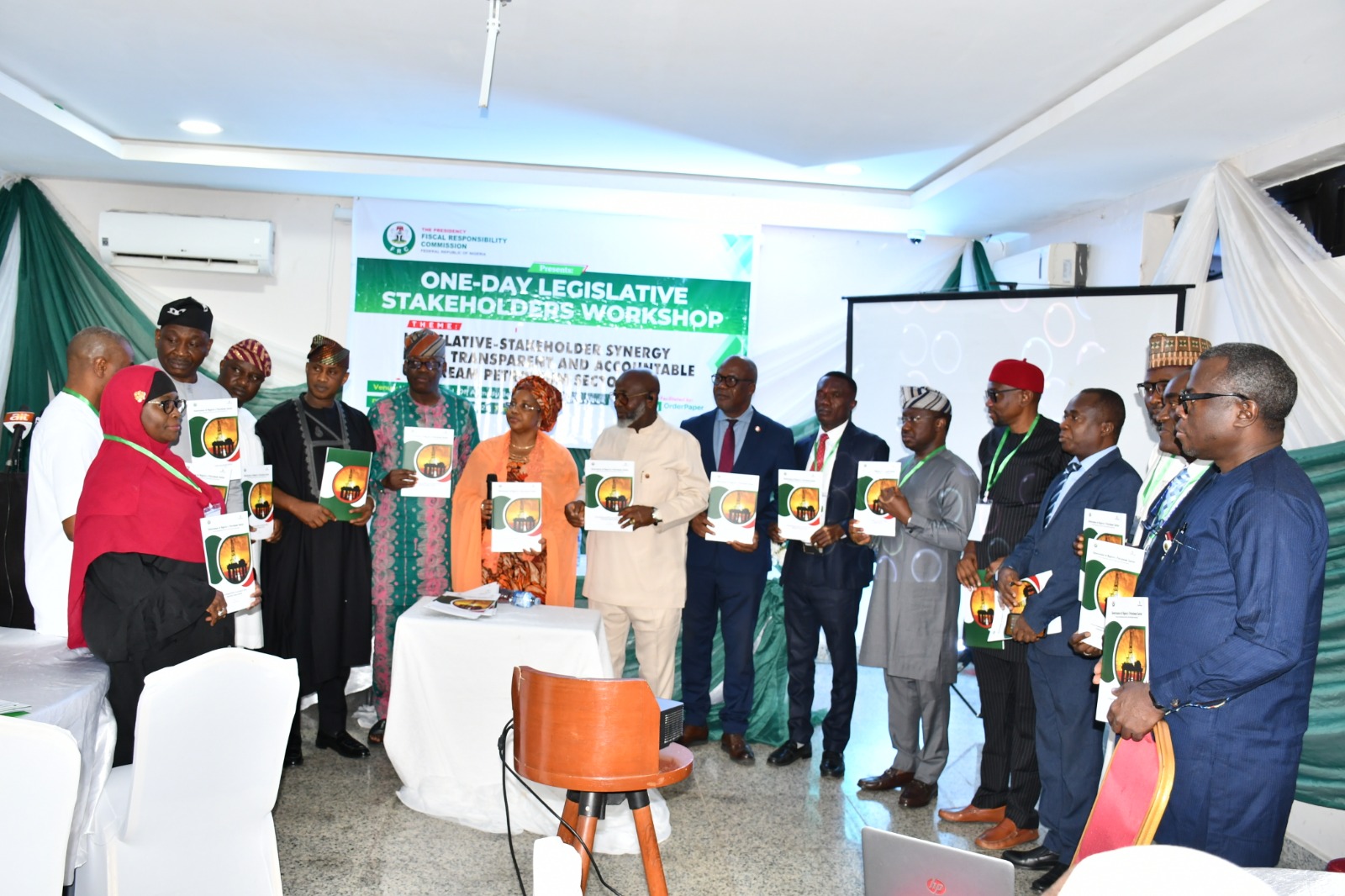
The workshop, which had as its theme, “Legislative-Stakeholder Synergy for Transparent and Accountable Upstream Petroleum Sector,” drew participants and resource persons from across the sector.
It also provided the platform for participants to examine the existing legal framework and institutional arrangements, as well as best practices that could enhance transparency and accountability globally, while strengthening collaboration among all stakeholders to achieve shared national objectives.
The workshop provided the opportunity to unveil a special publication on “Governance of Nigeria’s Petroleum Sector: Fiscal Imperatives and the 10th National Assembly,” by the FRC in collaboration with Order Paper, a parliamentary monitoring and policy think-tank to provide simplified and reliable data for citizens to facilitate their decision-making.
