


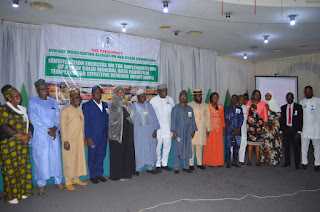
By Bassey Udo

A new reporting template that would cover the operations of all aspects of the solid minerals sector has been released,the Revenue Mobilization Allocation and Fiscal Commission (RMAFC) has said.
The new data reporting template developed in conjunction with the Federal Ministry of Solid Minerals Development is designed to capture and manage relevant information concerning the quantity of minerals produced, details of producing companies and their locations, as well as licenses, fees, and permits paid by mining companies.
The Chairman of the Commission, Dr. Muhammed Bello Shehu, who disclosed this in Abuja on Tuesday said the new template would make for effective monitoring of revenue realized from the operations of the solid mineral sector in Nigeria.
Shehu who was represented by the Chairman of the Solid Minerals Monitoring Committee of RMAFC at a one-day sensitization exercise on the implementation of the new template reiterated the Commission’s commitment to promoting the diversification of the nation’s revenue sources in line with the present administration’s vision to to harness the country’s revenue potentials from other key sectors of the economy such as solid minerals, tourism, manufacturing and the blue economy.
He underscored the importance of the new template, pointing out that its implementation could not have come at a better time, given the current economic realities the country was facing.
Emphasizing the need to diversify the national revenue sources, especially with the nation’s over-dependence on hydrocarbon revenues, which are often affected by fluctuations in the international crude 3oil market, as well as challenges such as crude oil theft and vandalism.
In line with the constitutional mandate of the Commission as enshrined in the 1999 Constitution (as amended), Dr. Shehu RMAFC conducted two nationwide solid mineral revenue monitoring exercises in 2016 and 2022 aimed at boosting revenue generation from the mining sector.
The two exercises, he said, had considerably improved the level of revenue generation from the sector.
However, he lamented that despite the growing scale of activities in the country’s mining sector, only a negligible amount was being remitted to the Federation Account.
The poor level of remittance from the sector, he said, was largely due to inadequate and ineffective monitoring of mining operations.
He therefore emphasized the determination of the Commission to work towards ensuring that all revenues due to the Federation Account from the mining sector were fully and promptly remitted.
The Chairman assured that the proper utilization of the data reporting template would enhance transparency and accountability by ensuring that mining operations and revenues were effectively tracked and managed.
In his remarks, the Chairman of the Solid Minerals Monitoring Committee, Ibrahim Shettima, who is also the Federal Commissioner representing Niger State in the Commission, stated that the event was organized to bridge identified gaps to engender the timely and accurate rendition of revenue data on a state-by-state basis by relevant government agencies and operators in the solid minerals sector.
Shettima explained that the exercise, which was aimed at establishing an independent, reliable data platform for the Commission, would serve as a credible source for comparison and policy decision-making.
Other stakeholders such as the Director, Mining Inspectorate, Federal Ministry of Solid Minerals, Engineer Imam Ganiu, Director General. Mining Cadastre Office, Engr. Obadiah Nkom, and the President of the Miners Association of Nigeria, Mr. Segun Ayanleke acknowledged Nigeria’s potential to be a key player in the global mining industry if the sector was efficiently and effectively managed.
They, therefore, called for proper implementation of policies around the sector to achieve optimal results.
They also advocated for stronger synergy between government and private stakeholders in the sector.
Papers were presented on the general overview of the global and Nigerian mining sectors, assessment of revenue contribution using data rendition, overview of the functions and activities of the Federal Ministry of Solid Minerals Development (FMSMD) as a major economic driver and the functions and activities of the Mining Cadastre Office (MCO).
Other presentations were on the role and experience of the Miners Association of Nigeria and the new data rendition template as a requirement for accurate and Timely Data Reporting in the Solid Minerals Sector.